Quick Answer
Washing usually removes salt residue and mildew, along with dirt and pollen. It does not fix efflorescence that keeps coming back, chalking paint, or rust bleeding from corroded hardware, because those come from the material or from moisture moving through it. Several of these look alike, so a close look and a small test area tell you more than color does.
Warrington sits close to Pensacola Bay and Bayou Grande, and humid, salty air reaches many homes. The marks it leaves are easy to lump together as “salt and mildew,” but they are not all the same problem, and only some of them wash off.
What Washing Removes and What It Does Not
| What you see | What it often is | What washing does |
|---|---|---|
| Gritty white film on windows, rails, or siding | Salt or mineral residue | Usually removes it |
| White crystals on brick, block, or stucco | Efflorescence | Removes the deposit; it can return until the water source is addressed |
| Powder that rubs off painted surfaces | Chalking paint | Removes loose chalk; the coating still needs repainting |
| Gray, black, or green spots in shaded areas | Mildew or other growth | Usually removes it |
| Orange-brown streaks below metal | Rust from fasteners, rails, or fixtures | May lighten them; they return until the hardware is replaced |
The two that cause the most confusion are efflorescence and chalking. The Brick Industry Association explains that efflorescence needs soluble salts, water, and a path for that water through the masonry, which is why it can come back after a wall is cleaned. Chalking is the paint itself breaking down. Sherwin-Williams describes it as a fine powder that forms as exterior paint weathers. Washing removes the powder but cannot restore the coating.

Why Color Alone Is Not a Diagnosis
White film on brick could be efflorescence, mortar residue, or leftover cleaner. Dark spots could be mildew, dirt, or soot. Three quick checks narrow it down:
- Rub test. Wipe a dry hand across painted siding. White powder on your palm points to chalking.
- Rinse and dry. Rinse a small patch of white film with fresh water and let it dry. If it stays gone, it was likely surface residue. If it returns on masonry, it may be efflorescence.
- Look above the mark. Streaks that start under a fastener, rail, or light fixture are usually coming from that metal.
A small test area during the wash confirms what lifts and what stays. Until then, any prediction from a photo is a guess.
When the Next Step Is Not Washing
- Efflorescence that keeps returning: look for the water source, such as gutter overflow, sprinkler spray, or cracks. A mason can help if water is entering the wall.
- Chalking paint: a painter can advise on preparing and recoating the surface.
- Rust bleed: replacing corroded fasteners or fixtures stops the staining at the source.
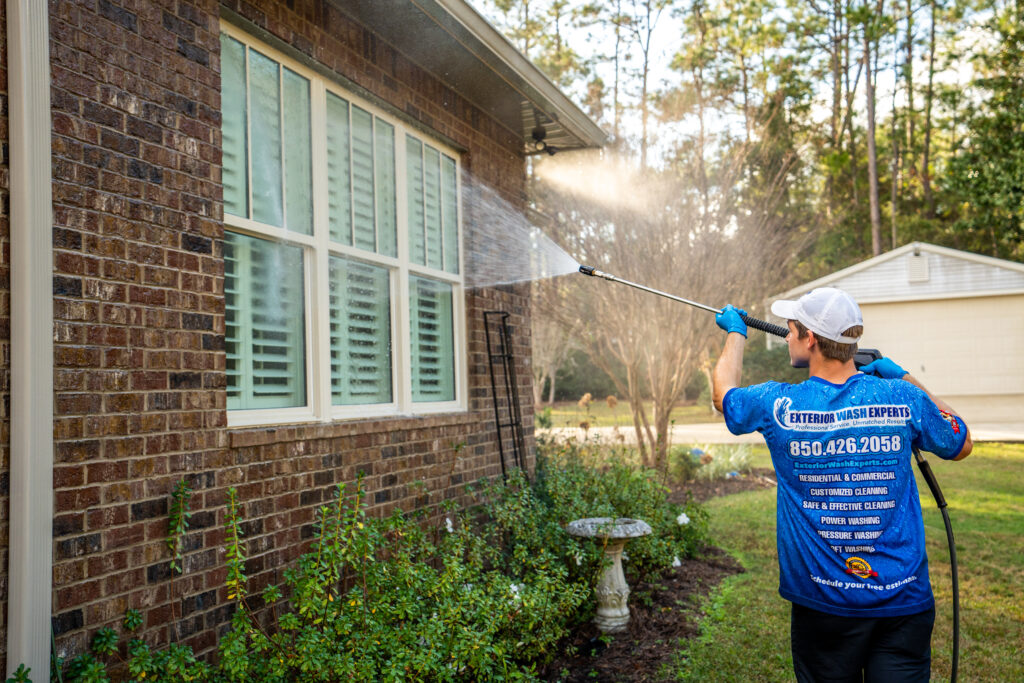
Exterior Wash Experts provides exterior house washing using a soft wash process on siding, with the cleaning solution matched to the surface.
Frequently Asked Questions
Is efflorescence a sign of a serious problem?
Usually not by itself. It shows that water is moving through the masonry, though, so heavy or persistent efflorescence is worth tracing to its source.
Can pressure washing fix chalking paint?
It can remove loose chalk, but high pressure can damage a weakened coating. Repainting is the actual fix, and cleaning is usually part of the preparation.
Is it worth rinsing my house after a storm?
A gentle rinse with a garden hose can remove fresh salt deposits from windows and siding before they build up. Avoid high pressure on siding.
Coastal moisture affects hardscapes too. If you have pavers, read our guide to paver cleaning and joint-sand loss in Oriole Beach.
Request an Estimate
If your Warrington home has white film or dark marks you want assessed, request an estimate online or call (850) 426-2058.